Serge Charchoune
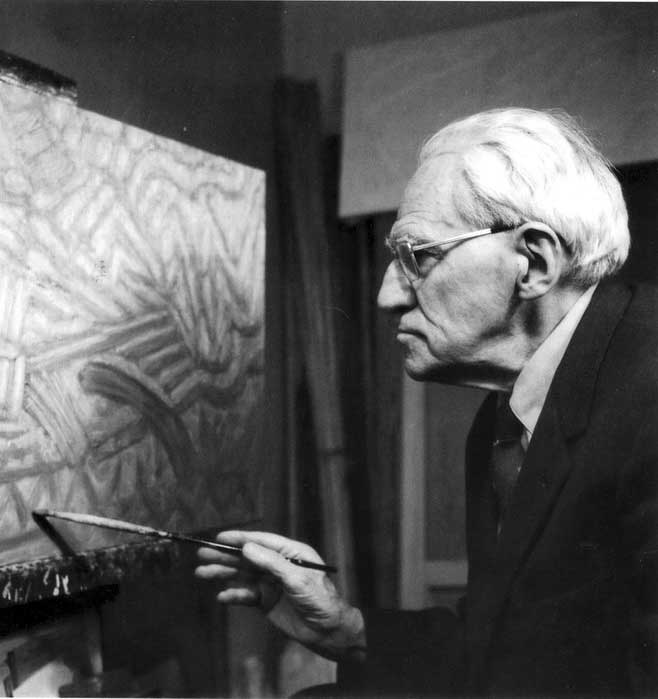
Sergei Ivanovich Charchoune was born in a family of merchants. The father did not support his son's passion for drawing, and his mother died when Sergei was 13 years old. In 1905, he finally entered the Kazan Art School and discovered painting as a "field of delights". Disagreements with his father led the young man to run away to join the army, and in 1909 he moved to Moscow. Serge Charchoune studied painting in Moscow and tried, without success, to enter the School of Fine Arts. He did not know how to draw: "I have always hated drawing, drawing and painting are, in my eyes, the greatest enemies". In 1912, after deserting military service, he arrived in Paris and enrolled in the studio of the Cubist painter Henri Le Fauconnier. After the declaration of war in August 1914, he took refuge in Barcelona with his sculptor partner Helena Grunhoff where he met the boxer-poet Arthur Cravan, the painters Albert Gleizes, Marie Laurencin and Francis Picabia. With Helena Grunhoff they exhibited together for the first time in 1916 at Josef Dalmau's, who was passionate about avant-garde art. Thanks to the latter, Charchoune exhibited abstract paintings that he himself described as "ornamental", as well as other works close to decorative arts and cubism.
After the Bolshevik revolution of October 1917, he gave up returning to Russia and returned to Paris. On May 26, 1920, he attended the Dada Festival at the Salle Gaveau and met Picabia again. He attended Dadaist meetings at the Café Certá (Passage de l'Opéra) and took part in Dada demonstrations, notably the "Barrès trial" organized by André Breton in May 1921. At the Dada salon at the Galerie Montaigne, organized by Tristan Tzara a month later, Charchoune exhibited drawings inspired by Picabia's "mechanical" works. He also composed a poem illustrated with twelve drawings, Foule immobile, which was very well received by the Dadaists.
In turn, he created a Dada group called Palata Poetov ("The Chamber of Poets") which met at the Café Caméléon, 146, boulevard du Montparnasse. On December 21, 1921, a "Russian Dadaist" evening was a failure despite the presence of Breton and Louis Aragon. Charchoune did not persist and, in May 1922, he went to Berlin, still hoping to obtain a visa for the USSR. There he created a Dada magazine in Russian Perevoz Dada ("The Dada Transporter") of which he wrote the first issue alone (June 1923). After editing an anthology of German, French and Russian Dadaist poetry Dadaizm, kompilacija and collaborating on various magazines such as Merz by Kurt Schwitters, Charchoune abandoned the movement. In 1922, in Berlin, he exhibited a new series of paintings at the Der Sturm gallery that he called "ornamental cubism". He met Russian artists disappointed by the revolution, including the dancer Isadora Duncan. Charchoune then gave up on returning to the USSR and returned to Paris (1923).
In 1925, Charchoune met Amédée Ozenfant in Paris, with whom he formed a friendship; thanks to Ozenfant's influence, he then began his purist period, certainly one of his finest periods. With Ozenfant and Le Corbusier, he participated in the magazine "L'Esprit Nouveau" with many other artists: Lhote, Valmier, Picasso, Apollinaire, Cocteau, Breton, Léger.
In 1926, he participated in the Retrospective of the Salon des Indépendants4. After his meeting with Amédée Ozenfant, he definitively adopted purism and produced numerous works. Ozenfant introduced him to the Percier Gallery and its director André Level who offered him his first major exhibition. At the Percier Gallery he met other painters including René Rimbert who would become his friend and with whom he would begin a dense correspondence. Between 1931 and 1950 Charchoune would experience his darkest, most difficult period. In 1930 due to the economic crisis he sold nothing, exhibited little and lived in the greatest destitution, he withdrew into himself. However, he would meet two dealers, Raymond Creuze and Edwin Livengood who both believed in his painting and who would allow him to survive. Little by little several personal exhibitions allowed him to sell a few paintings. This was not a major period in his creation but a renewal was taking shape with the appearance of two essential elements of inspiration: water and music. These elements would never leave him and Charchoune then dominated his subject. He was inspired by the great musicians and monochromes appeared. From 1954 his work became more and more abstract and stripped down, the monochromes turned to white with more or less material. He then met Pierre Lecuire and his protégé Nicolas de Staël. De Staël was fascinated by Charchoune and would say of him: "he is the greatest among us". Another meeting would be important, that of René Guerra, professor of Russian literature at the Sorbonne.
In his small studio at Porte de Vanves, Charchoune painted with a small transistor radio at his side that played: Bach, Mozart, Vivaldi, Beethoven... The compositions intertwined music and the ever-present water. He made a long initiatory journey to the Galapagos Islands, which in his eyes represented the best that nature could offer man. In 1974, Rimbert, during one of his exhibitions at the Galerie Berri Lardy, introduced him to a young collector: Pierre Guénégan, who published the catalogue raisonné of his entire painted work thirty years later. In 1971, he finally received national recognition with a retrospective dedicated to him at the Musée National d'Art Moderne in Paris. He exhibited a hundred works that traced his entire career. In 1975, he passed away, the journey was over, he had produced more than five thousand paintings; he died leaving a considerable mark on the painting of his time. Pierre Lecuire and René Guerra are his executors and accompany him to his final resting place, his final initiation.